World Center for Strategic Studies
From closed analysis to public debate
- MONTH
- YEAR

Europe’s Paperwork Fix Won’t Save It: Scale Is the Real Problem
CEPS’s commentary delivers a clear warning to Brussels: cutting red tape is useful, but it will not make Europe competitive on its own.
The EU is talking hard about simplification, burden reduction and lighter reporting.
But the bigger weakness sits underneath – fragmented markets, small-scale firms and a governance machine that makes cross-border business harder than it should be.
Europe can trim forms, shorten procedures and tidy rules, but rivals will still beat it if European companies cannot grow at continental scale.
Red tape is not the whole disease
The EU’s regulatory system has become heavy after years of financial reforms following the global financial crisis.
That framework helped stabilise the system. But it also created overlapping reporting duties, documentation demands, high compliance costs and long implementation cycles that frustrate firms and regulators alike.
Simplification is justified. The commentary does not deny that. But it warns against pretending that lighter paperwork equals restored competitiveness.
Europe did this to itself
The real problem is not just badly written rules. It is the structure of Europe’s market.
EU regulation often becomes complex because it tries to fit different national preferences, business models and market structures into one system. That is the hidden cost of keeping harmony while preserving flexibility.
Fragmentation then feeds complexity. National transposition, supervisory habits, guidance, gold-plating and risk-averse compliance practices pile extra burdens onto businesses even when EU law itself is not the only culprit.
The single market is still too small in practice
The commentary’s sharpest point is about scale.
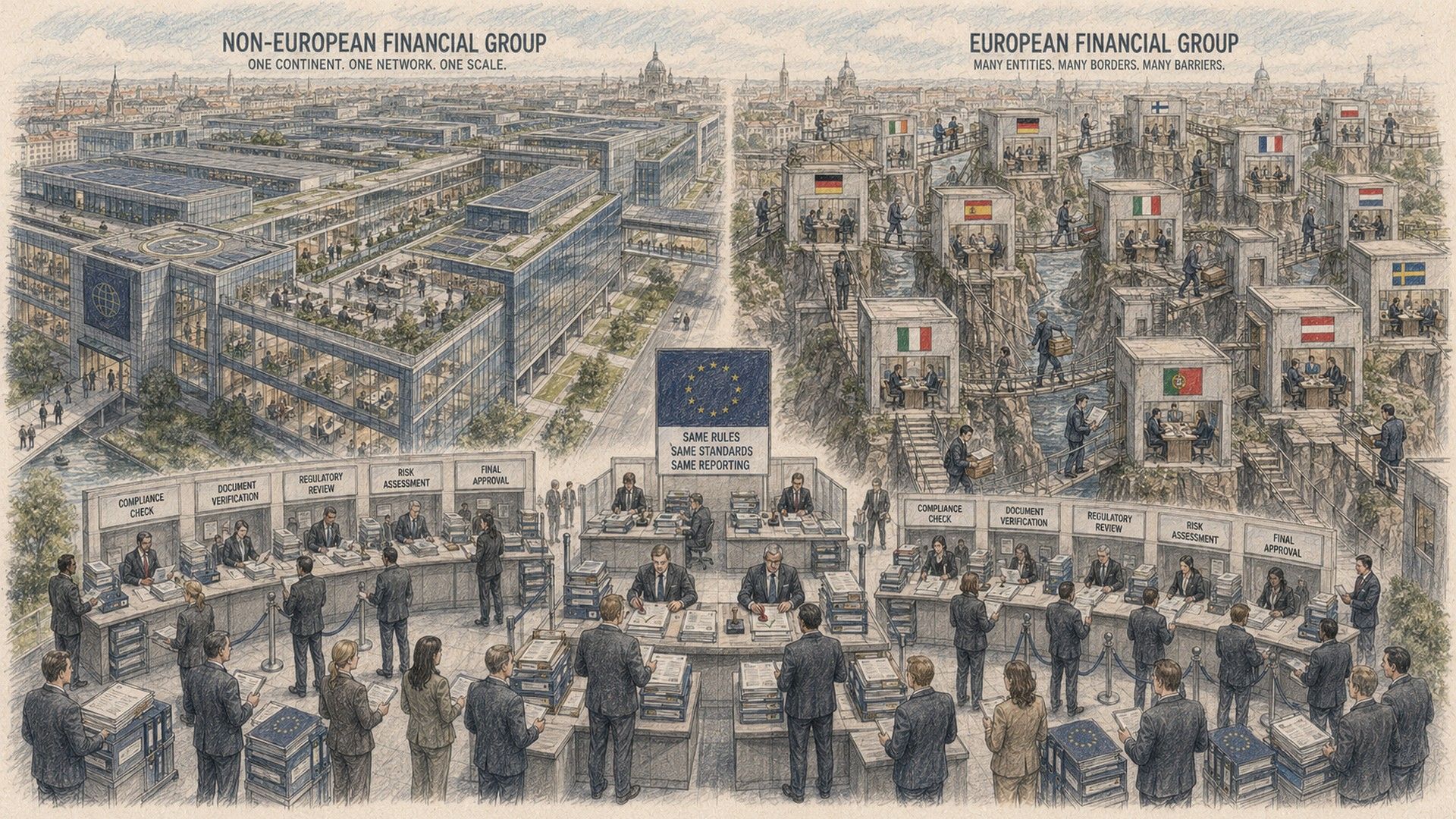
European firms are not losing only because compliance costs are too high. In some areas, non-European competitors operate under the same rules in Europe and still perform better.
That exposes the harsher truth: European capital markets are too fragmented. Companies struggle to expand, consolidate and build the business models needed to compete globally in investment banking, securities services, capital markets and wholesale finance.
Size matters – and Europe lacks it
The Savings and Investment Union is framed as part of the answer because it targets the missing ingredient: integrated markets.
A simpler template or shorter reporting form may help at the margins. But it will not create champions, deepen markets or unlock investment across borders.
Europe needs firms able to operate across the continent as one market, not as a patchwork of national systems stitched together by compromise.
Process is eating strategy
The EU’s governance model is another drag.
Framework laws, delegated acts, implementing measures, technical standards, supervisory guidance and national procedures all have their place. But together they create ambiguity, slow decisions and add cost for regulated firms.
The problem is timing too. EU lawmaking is slow while markets and technology move quickly. By the time a rule is debated, adopted and implemented, the world may already have changed.
Predictability beats perfection
CEPS argues that Europe may need to accept some imperfection in exchange for stability.
Constantly reopening rules to fix every flaw can make the system more precise, but also less predictable. Firms and supervisors then face regulatory fatigue instead of confidence.
The better route is clearer Level 1 legislation, tighter control over technical mandates, stronger proportionality and more serious cost checks before implementation.
The key point: Europe cannot simplify its way to power.
The commentary’s message is sobering: simplification is only one tool in a much bigger competitiveness fight. The EU must tackle fragmentation, deepen the single market, improve governance and help firms grow at European scale.
Brussels can cut burdens and still lose the race.
The real prize is not fewer forms. It is a market big enough to matter.