World Center for Strategic Studies
From closed analysis to public debate

- MONTH
- YEAR

Europe’s Defence Buying Rules Failed – Now Brussels Wants Another Shot
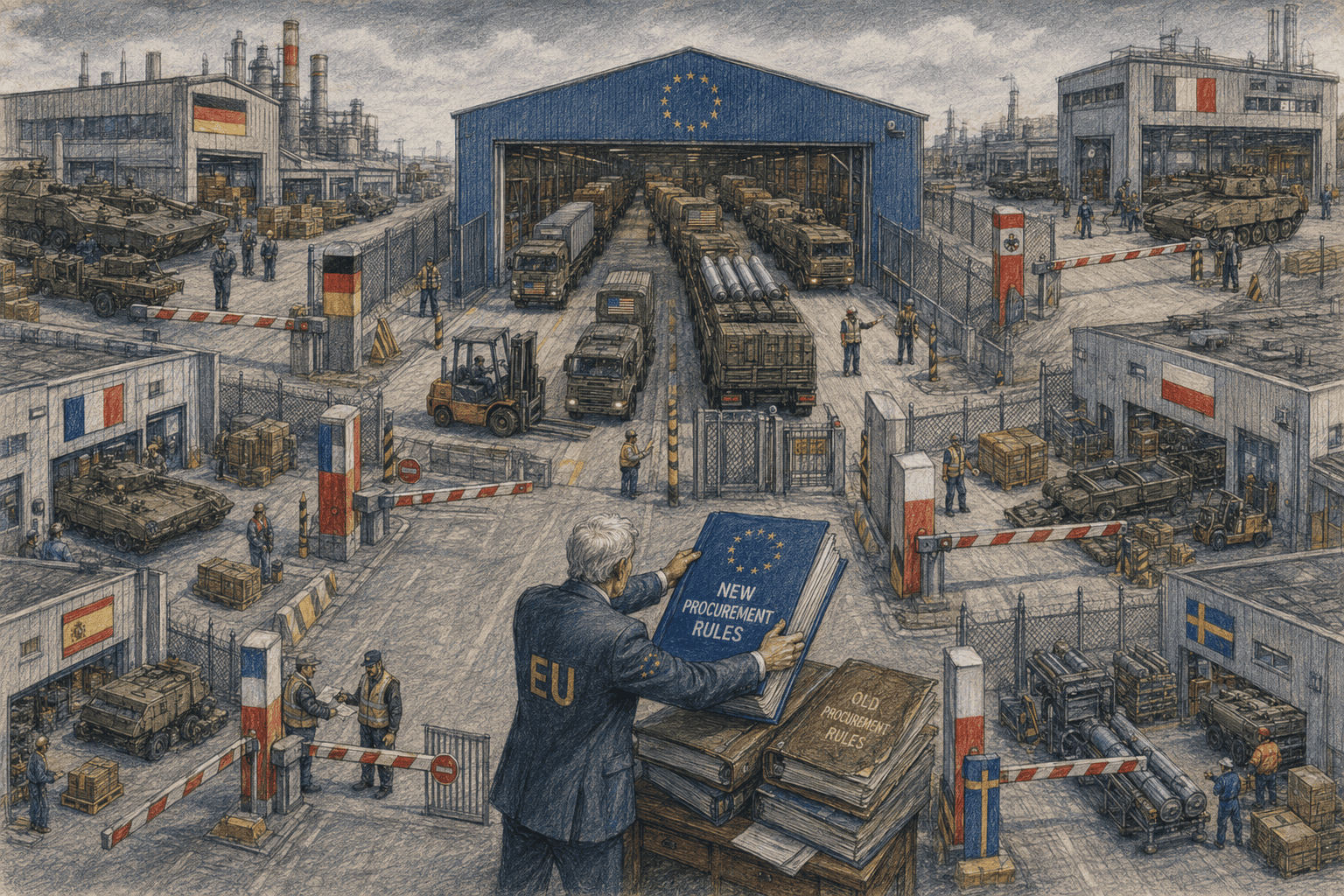
Europe has spent 15 years pretending it has a common defence procurement market. In reality, most governments ignored the rules, protected national champions and kept buying heavily from outside the EU, especially the United States.
Now Brussels wants to rewrite the system just as Europe faces war, industrial shortages and doubts over US security guarantees. The IRIS paper’s message is stark: reform will fail again unless the EU stops treating defence like an ordinary market and openly backs European industry.
The old system barely worked
The 2009 defence procurement directive was supposed to open national markets and reduce fragmentation.
Instead, implementation remained weak. Around 80 per cent of defence purchases are still estimated to be made through direct awards, while roughly 70 per cent of contracts go to domestic suppliers.
When governments do buy abroad, they often prefer non-EU suppliers to European competitors.
Europe built loopholes – America used them
One of the clearest failures is government-to-government procurement.
EU rules allowed exemptions for these deals, but Europe never created anything as efficient as the US Foreign Military Sales system. American suppliers therefore gained a major advantage while European governments continued talking about industrial autonomy.
The result is hard to miss: European rules helped create a market that remained fragmented at home and open to Washington.
France, Germany and Poland want different things
The reform is already colliding with national priorities.
France wants European preference and protection for strategic industrial sovereignty. Germany wants faster, simpler purchasing rules so its new defence money can actually be spent. Poland wants local production and industrial offsets to strengthen its own defence sector.
These goals are not impossible to reconcile, but they expose why previous EU rules were so easy to bypass.
Process is eating strategy
Brussels wants more competition, more SMEs, faster procurement and less bureaucracy.
But defence is not a normal consumer market. Governments care about supply security, intellectual property, political alliances, local jobs and freedom to modify and use weapons without foreign permission.
If the Commission focuses only on competition and procedure, the reform risks repeating the same mistake under a new label.
Buy European – or stay dependent
IRIS argues that any serious reform must introduce a stronger European preference.
That could include easier procurement for systems genuinely designed and controlled inside Europe, rather than simply assembled there under foreign licences.
A proposed Made and Designed in Europe approach would focus on intellectual property and design authority instead of forcing officials to trace every component inside complex weapons systems.
Washington remains the awkward obstacle
Several governments still believe buying American weapons helps preserve US security guarantees.
Germany, Poland and the Baltic states are particularly cautious about shutting US suppliers out, while other countries have defence industries deeply tied to American or British companies.
That leaves Europe trapped between two objectives: autonomy in theory and transatlantic dependence in practice.
Brussels may need to bribe governments into autonomy
The paper also floats a more aggressive incentive: give countries extra fiscal room when they buy European equipment or join European procurement programmes.
A mechanism inspired by the EU’s budgetary escape clause could make European purchases financially more attractive, particularly for countries with healthier public finances.
It would be complicated, but the logic is clear – European preference may need money behind it, not another declaration.
The uncomfortable truth: Europe still buys sovereignty from abroad
The EU cannot build strategic autonomy while its defence market remains dominated by national protectionism on one side and dependence on non-European suppliers on the other.
If Brussels reopens the rules, the objective cannot simply be more competition. It has to be a harder industrial strategy built around European production, European technology and secure European supply chains.
Otherwise, Europe will reform the paperwork and keep the dependency.