World Center for Strategic Studies
From closed analysis to public debate
- MONTH
- YEAR

France’s Sovereignty Gamble: Bardella-Farage Pact May Give Britain the Better Deal
Jordan Bardella and Nigel Farage are trying to look less like protest leaders and more like prime ministers-in-waiting. Institut Montaigne sees their Birmingham summit as a calculated credibility operation, with migration and sovereignty used to advertise a new nationalist cooperation across the Channel. But behind the choreography sits an awkward problem for France – their headline migration pact appears less favourable to Paris than the deal already in force. The bigger experiment is whether nationalist parties can cooperate across Europe while attacking the EU model built to organise that cooperation.

Yesterday’s outcasts now smell power
The transformation is striking. Farage refused to ally with Marine Le Pen’s Front National in 2014 and was still attacking the RN’s economic programme in 2024.
Now Farage and Bardella present themselves as potential future government partners. Their parties no longer behave like permanent opposition movements – they are rehearsing for power.
The radical right has moved again
Their normalisation has been helped by another shift. More radical competitors have emerged to their right, including Reconquête in France and Restore Britain in the UK.
That pushes the political boundary further out. As RN and Reform UK grow stronger and more respectable, forces once treated as political outsiders can increasingly present themselves as the comparatively moderate option.
France gives away the advantage
Migration produced the summit’s biggest headline – and its most uncomfortable detail for Bardella.
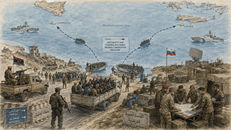
Under the memorandum, an RN government would try to stop migrant boats leaving France, while Britain could return intercepted migrants to French territory. Yet France and Britain already have a one-for-one arrangement negotiated by Emmanuel Macron and Keir Starmer.
The Bardella-Farage plan keeps the British prize – returns to France – while dropping Paris’s key compensation of legal transfers to Britain. Institut Montaigne’s assessment is hard to escape: on readmissions, the balance tilts towards London.
The spectacle outruns the substance
The agreement sounds dramatic but changes little immediately. Neither party is in government, the memorandum has no binding force, and France and Britain already strengthened patrols, intelligence-sharing and anti-crossing measures in April 2026.
Its real significance is political theatre with strategic intent. RN and Reform are negotiating publicly as though the governments of France and Britain already belong to them.
Europe without Brussels
Bardella’s broader pitch is more ambitious than migration. He wants cooperation on defence, nuclear power, artificial intelligence and maritime security while separating European cooperation from deeper EU integration.
Britain after Brexit becomes a useful exhibit for that argument – European states can supposedly work closely together without surrendering sovereignty to Brussels.
But Birmingham exposes the weakness in the sales pitch. Cooperation between sovereign governments still requires bargaining, compromise and competing national interests. Taking back control does not make those conflicts disappear.
The warning sign: Sovereignty gets messy when interests collide
Bardella and Farage have made their partnership look increasingly plausible as both movements move closer to power. What they have not proved is that their alternative model can deliver better outcomes than the institutions they attack.
On their first showcase deal, Britain may already have more to gain than France.