World Center for Strategic Studies
From closed analysis to public debate

- MONTH
- YEAR

Europe’s AI Mega-Bet Could Backfire: Brussels Risks Building Yesterday’s Technology
Europe is preparing to pour billions into giant AI data centres just as the technology underneath them could be changing. The EPC warns that Brussels risks confusing Silicon Valley’s current business model with the infrastructure Europe will actually need for its future AI economy.
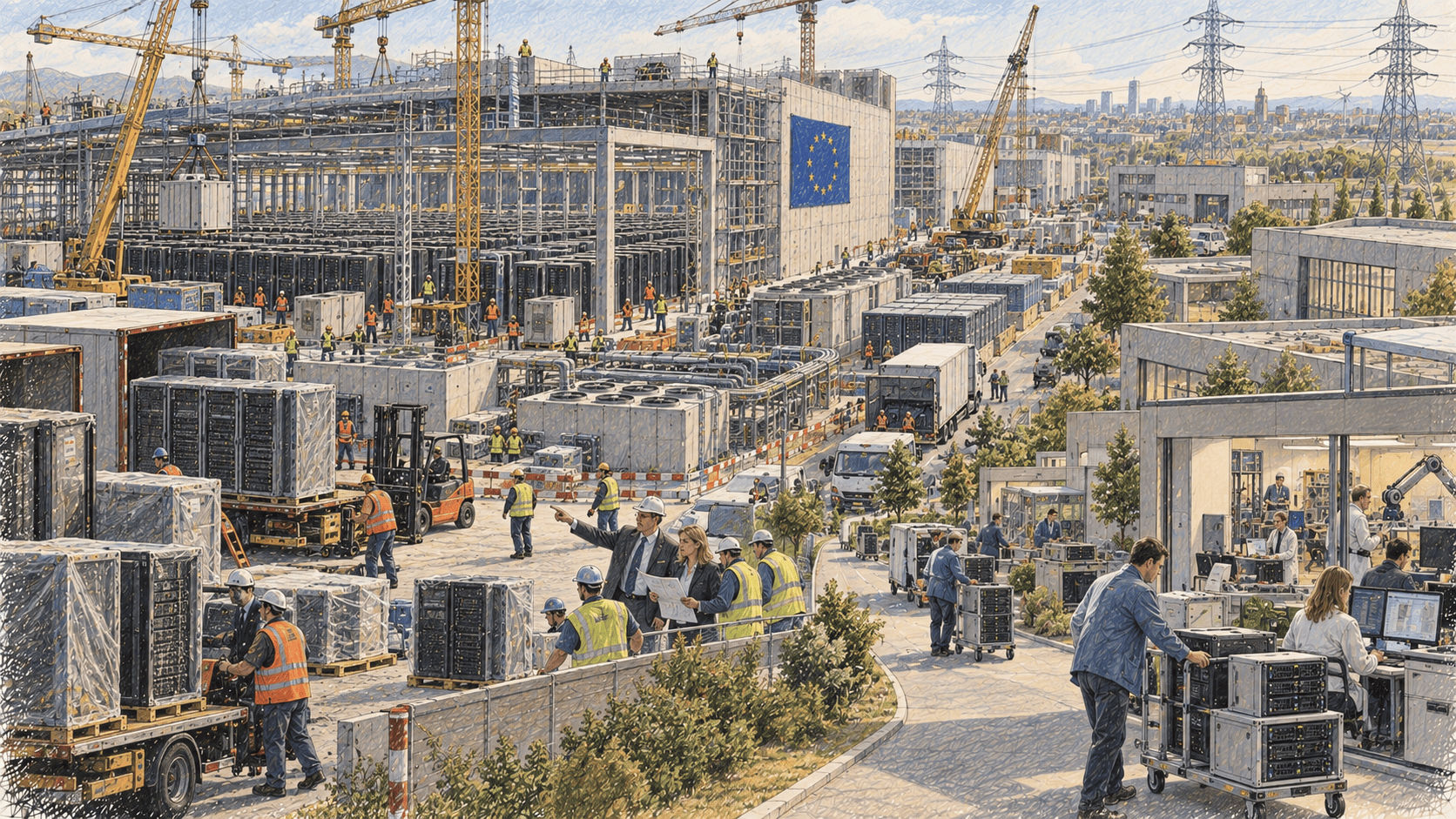
The Commission wants to at least triple EU data-centre capacity within five to seven years, while up to seven AI gigafactories could receive €10 billion in public backing to unlock at least €20 billion privately. Europe desperately needs more computing power – but betting too heavily on hyperscale centres could leave it with huge energy bills, concentrated security risks and expensive infrastructure that becomes outdated before it pays off.
Silicon Valley sets the model
Today’s AI giants rely on enormous concentrations of processors, electricity, water and capital to train and operate increasingly powerful models.
That architecture can look technologically inevitable. The EPC argues it is not.
It partly reflects the commercial strategies of dominant AI companies. Europe risks reorganising energy systems and industrial policy around those choices before establishing whether its own economy needs the same model.
Brussels could lock itself in
Data centres, power stations and transmission infrastructure last for decades. Computing technologies can change dramatically within years or even months.
Once Europe spends heavily on hyperscale infrastructure, reversing course becomes difficult.
The danger is a classic lock-in: Brussels could commit vast resources to solving today’s compute problem only to discover that tomorrow’s AI needs less centralised infrastructure.
Smaller could beat bigger
Not every AI application needs a gigantic data centre.
Smaller specialised models, dedicated processors and increasingly powerful local devices can shift computation closer to users. Distributed and edge computing can also fit more easily with renewable-heavy electricity systems.
The EPC therefore favours a mixed architecture – hyperscale where genuinely necessary, distributed computing where possible and specialised hardware where it delivers better efficiency.
Concentration creates another weakness
Putting enormous computing capacity into a handful of facilities also creates physical security risks.
Recent Iranian drone attacks damaged three Amazon data centres in the UAE and Bahrain, with some customer data reportedly impossible to restore.
As computing becomes critical infrastructure, concentrating it means concentrating potential targets. Europe could build technological power while simultaneously creating vulnerable points of failure.
Quantum could scramble the calculation
Quantum computing adds another reason for caution.
It cannot replace conventional AI processors today, but certain specialised tasks can already be performed with radically different energy requirements. The EPC highlights D-Wave’s claim that its quantum machine solved a complex materials problem in minutes while consuming about 12 kilowatts, compared with roughly 20 megawatts for the Frontier supercomputer used for comparison.
The broader lesson is more important than any single experiment: tomorrow’s computational power does not automatically require ever-larger versions of today’s infrastructure.
Sovereignty is more than concrete and chips
Building giant data centres on EU territory does not automatically deliver technological sovereignty.
For the EPC, real sovereignty means Europe can switch suppliers, protect its data and keep critical systems operating when technology, markets or geopolitical conditions change.
A rigid infrastructure model could therefore produce exactly the opposite – enormous sunk costs that reduce Europe’s freedom to adapt.
The big warning: Europe could spend billions backing the wrong future
Europe entered the AI race late, but that delay gives it one advantage – it can watch the weaknesses of the American hyperscale model before copying it.
The EU needs serious computing capacity. What it does not need is to spend a generation building Silicon Valley’s answer to yesterday’s problem and discover that the technology moved on first.