
World Center for Strategic Studies
From closed analysis to public debate

- MONTH
- YEAR

Europe’s Workforce Crisis: Brussels Needs New Members to Keep Its Economy Running
Europe is running out of workers – and its next enlargement could provide part of the answer. CEPS warns that shrinking working-age populations and rapid ageing are putting growing pressure on European businesses, public services and economic growth. The nine EU candidate countries could bring another 65 million people into the Union, including younger, increasingly skilled workers who could help ease labour shortages. But enlargement carries a serious risk: if Brussels simply draws workers away from poorer neighbours without helping their economies develop, it could solve one labour problem by creating another.
Europe’s demographic squeeze is getting worse
The EU’s working-age population is shrinking while the number of older people continues to rise.
Employers across member states already struggle to recruit workers with the right skills. As ageing accelerates, shortages threaten to constrain production, weaken growth and put additional pressure on pension and social security systems.
CEPS argues that enlargement should therefore be seen not only as a geopolitical and security project but also as an opportunity to strengthen Europe’s labour force.
The next expansion is smaller than it looks
Political fears about another wave of enlargement often overlook the numbers.
The nine candidate countries together have around 65 million inhabitants, compared with 107 million added through EU enlargement rounds since 2004.
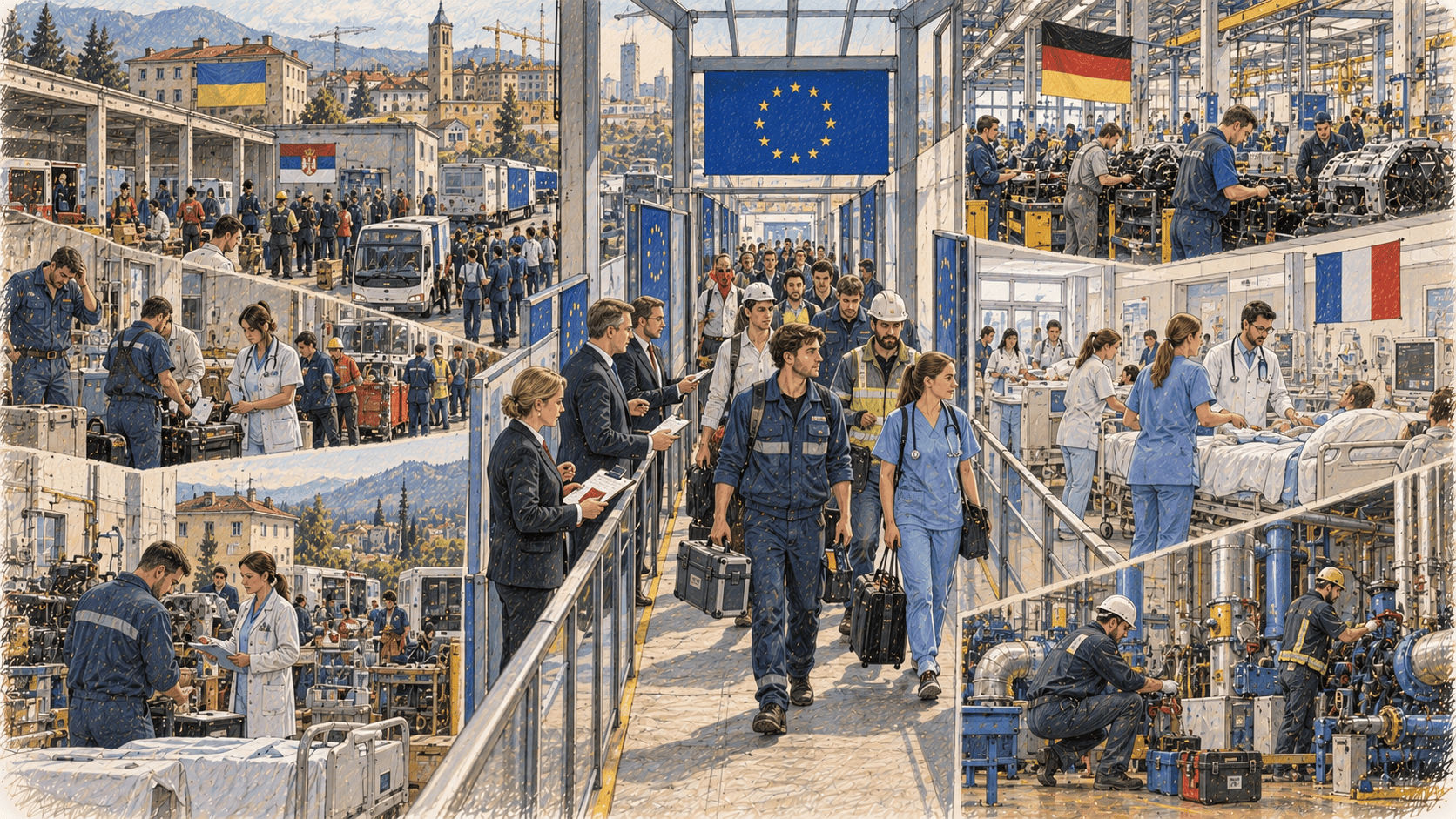
Much of the labour-market adjustment has already happened. Large numbers of Western Balkan citizens already live and work in the EU, while millions of Ukrainians have entered European labour markets under temporary protection.
The next enlargement would formalise economic connections that already exist rather than create them from scratch.
Europe needs their skills
Candidate countries offer more than additional workers.
CEPS highlights their relatively young, educated and skilled populations, many of whom are already integrated into EU labour markets.
If successfully employed, these workers could help fill shortages while contributing taxes and social security payments.
But qualifications and experience must be properly recognised. Without effective skills matching, Europe risks wasting human capital even as employers complain they cannot find staff.
The brain drain could punish new members
The biggest danger lies on the other side of the border.
If accession accelerates the departure of young and qualified workers, candidate countries could lose precisely the people they need to modernise their own economies.
That would deepen demographic pressure and undermine the economic convergence enlargement is supposed to deliver.
CEPS stresses that migration need not become a permanent one-way flow. Better jobs, higher productivity and rising incomes at home can encourage workers to return or move between countries.
Brussels must stop treating mobility as a threat
Previous enlargements show that some additional migration follows accession. But blanket restrictions are not necessarily the answer.
CEPS recommends using transitional arrangements selectively and coordinating them at EU level rather than allowing national governments to impose poorly aligned barriers.
The priority should be fair mobility, better recognition of skills and systems that connect workers with genuine labour-market demand.
Cities could pay the immediate price
Even when migration benefits the wider economy, its local effects can be uneven.
Some cities and regions may face additional pressure on housing, infrastructure and public services as workers arrive.
CEPS therefore calls for targeted financial support where adjustment costs are concentrated. Without such measures, local strains could fuel political opposition to enlargement despite its broader economic benefits.
The verdict: Europe needs workers, not another migration backlash
CEPS wants the EU to put productivity, job creation and economic convergence at the heart of pre-accession support, while encouraging circular and return migration.
Enlargement could strengthen Europe's workforce and help candidate countries prosper. But if Brussels fails to manage mobility fairly, it risks draining talent from its future members while creating fresh tensions inside the Union.
Europe cannot afford to waste the demographic opportunity – or leave its new members paying the price.